
@miragon/rules/element-id-naming
Reports an element whose ID does not follow the project's naming convention.
Examples
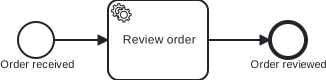
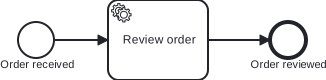
OrderReceivedElement id must match the naming convention <startEvent_camelCase>ReviewOrderElement id must match the naming convention <serviceTask_camelCase>OrderReviewedElement id must match the naming convention <endEvent_camelCase>ReceivedToReviewElement id must match the naming convention <flow_camelCase>ReviewToReviewedElement id must match the naming convention <flow_camelCase>
Invalid: readable labels, but IDs with no type prefix (ReviewOrder, not serviceTask_reviewOrder)
The same, as XML. 👎 wrong:
<bpmn:serviceTask id="Activity_0049ryx" name="Claim membership" />
<bpmn:serviceTask id="serviceTask_ClaimMembership" name="Claim membership" />
<bpmn:serviceTask id="task_claimMembership" name="Claim membership" />
👍 right:
<bpmn:serviceTask id="serviceTask_claimMembership" name="Claim membership" />Why
Wherever an element ID surfaces (a test assertion, an incident in monitoring, a generated constant, a diff) someone has to read it and know what it points at. A naming convention makes that instant: the prefix says what type the element is, the name says what it does, so a developer or a business stakeholder recognises the step without opening the model. Without one the same ID is just a string.
serviceTask_claimMembership     what it is, and what it does
Activity_0049ryx                neither
Why this matters for agentic BPMN
An agent navigates a model by its IDs: to identify an element, describe a change, or apply a targeted edit, it needs IDs that are structured and categorisable. Without a prefix convention the IDs are arbitrary strings that carry no type information a machine can key off.
Typical AI artifact without this rule: a mix of Activity_1, task_claim and ServiceTask_Claim for elements of the same kind: no shared shape an agent can rely on to tell a gateway from a task from a flow.
What this rule guarantees: every ID follows one <typePrefix>_<Name> convention, so both a reviewer and an agent can read an element's type and purpose straight off its ID and address it unambiguously.
Default convention
A camelCase element-type prefix plus a camelCase name.
| Element type | Prefix |
|---|---|
bpmn:StartEvent | startEvent_ |
bpmn:EndEvent | endEvent_ |
bpmn:BoundaryEvent, bpmn:IntermediateCatchEvent, bpmn:IntermediateThrowEvent | event_ |
bpmn:ServiceTask | serviceTask_ |
bpmn:UserTask | userTask_ |
bpmn:SendTask / ReceiveTask / ManualTask / ScriptTask | sendTask_, … |
bpmn:BusinessRuleTask | businessRuleTask_ |
bpmn:Task | task_ |
bpmn:CallActivity | callActivity_ |
bpmn:SubProcess | subProcess_ |
bpmn:Gateway (every kind) | gateway_ |
bpmn:SequenceFlow | flow_ |
Types are resolved by exact $type first, then by inheritance, so bpmn:Transaction and bpmn:AdHocSubProcess pick up the sub-process convention, and every gateway kind picks up gateway_, without being listed. Because the exact $type wins over the inheritance fallback, switching a concrete type off with false (or overriding it) also stops it from inheriting a base convention — and the concrete task types each need their own entry, since the default map lists them individually rather than only bpmn:Task.
Two things are intentionally left out. bpmn:Process is not covered: a process ID is a public contract (the deployment key, and what a call activity references), not a diagram-internal identifier. Any type not in the table is skipped too, so an exotic element nobody configured never produces a report.
Event-definition qualifiers
An event id may optionally name its event definition — messageStartEvent_membershipRequested instead of startEvent_membershipRequested. The accepted set is derived from the element's own<bpmn:*EventDefinition> children, so a qualifier that matches passes and a qualifier that lies is reported. The qualifier is the definition name lowercased (bpmn:TimerEventDefinition → timer): message, timer, signal, conditional, escalation, error, link, terminate, compensate. It is prepended to whatever prefix the type resolves to (startEvent_ → timerStartEvent_, a custom boundaryEvent_ → messageBoundaryEvent_).
eventDefinitionQualifier controls this:
| mode | accepted for a message start event with prefix startEvent_ |
|---|---|
optional (default) | startEvent_… or messageStartEvent_… |
required | messageStartEvent_… only (plain prefix when no definition) |
off | startEvent_… only |
👍 startEvent_membershipRequested         always valid
👍 messageStartEvent_membershipRequested  it IS a message start event
👎 timerStartEvent_membershipRequested    no timer event definition
The default optional only widens what passes, so enabling the rule never rejects an id that was valid before. A lying qualifier gets its own message — Element id claims a timer event, but this element has no timer event definition — separate from the plain wrong-prefix / wrong-case one.
Configuration
{
  "rules": {
    "@miragon/rules/element-id-naming": [
      "error",
      {
        "prefixes": {
          "bpmn:SequenceFlow": "Flow_",
          "bpmn:ScriptTask": false
        },
        "case": "snake_case",
        "eventDefinitionQualifier": "optional"
      }
    ]
  }
}prefixes: merged over the defaults, so you only state what differs.falseswitches a type off entirely.case: the shape of the part after the prefix:camelCase(default),PascalCase,snake_caseorany.eventDefinitionQualifier: whether an event id may name its event definition —optional(default),requiredoroff. See Event-definition qualifiers.
Further reading
- Camunda: Naming technically relevant IDs: "Define developer-friendly and business-relevant IDs" with a structured type-prefix convention (e.g.
Task_ReviewTweet,Gateway_TweetApproved). - Camunda: Naming BPMN elements: name a task "using an object and a verb", which is what the name part encodes.
Related
@miragon/rules/no-generated-ids: the subset of this rule that needs no convention agreed on first.