
@miragon/rules/no-generated-ids
Reports IDs that were generated rather than chosen.
Examples
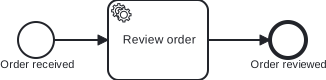
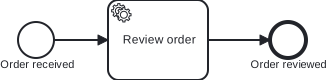
StartEvent_1Element id looks generated — give it a readable, stable nameActivity_0049ryxElement id looks generated — give it a readable, stable nameEvent_1x9j8k7Element id looks generated — give it a readable, stable nameFlow_0a1b2c3Element id looks generated — give it a readable, stable nameFlow_1sy6h9pElement id looks generated — give it a readable, stable name
Invalid: every ID is a generated token
The same, as XML. 👎 wrong:
<bpmn:serviceTask id="Activity_0049ryx" name="Review request" />
<bpmn:startEvent id="StartEvent_1" name="Request received" />
👍 right:
<bpmn:serviceTask id="serviceTask_ReviewRequest" name="Review request" />
<bpmn:startEvent id="startEvent_RequestReceived" name="Request received" />
Why
An element ID is not diagram-internal. A process test asserts against it (hasPassed("serviceTask_reviewRequest")), and monitoring labels a running instance or an incident with it (Camunda Operate, Cockpit). So a developer debugging a failing test and a business stakeholder watching an incident in monitoring both read that ID straight, and a generated token like Activity_0049ryx tells neither of them which step it is. It also churns on every regeneration, so a test pinned to it and its line in a diff break for no reason.
Unlike element-id-naming this rule enforces no convention of its own, which makes it the cheap first step for a codebase that has not agreed on one yet:
{
  "extends": "bpmnlint:recommended",
  "rules": { "@miragon/rules/no-generated-ids": "error" }
}
Why this matters for agentic BPMN
This is the highest-yield check for an AI-authored model. An agent extending a diagram copies the modeler's habit of stamping a random token and repeats it on every edit. Nothing downstream complains, so without this rule the model quietly fills with IDs that mean nothing to the next reader or agent.
Typical AI artifact without this rule: a freshly added <bpmn:serviceTask id="Activity_0049ryx"> sitting next to hand-named elements, unstable across edits and impossible to reference from a generated constant or a test.
What this rule guarantees: every element carries a chosen, stable ID, so diffs stay readable and any tool, test or agent can point at an element by a name that survives the next edit.
What counts as generated
Two patterns, both taken from real modeler output rather than guessed at:
- A random token:
Activity_0049ryx,Gateway_1x9j8k7,Flow_0a1b2c3. bpmn-io's modeler emits a 7-character base-36 token; the rule accepts 6 to 8 for tolerance. The token must mix letters and digits, which is what separates it from a real word: a random modeler token always contains a digit, and an ordinary word in that length window does not, soflow_nospotsandtask_invoiceare safe. - A bare counter:
StartEvent_1,Flow_2, the older modeler form.
A second underscore disqualifies both, so a deliberate userTask_Approve_2 is left alone.
Scope
Flow nodes, sequence flows, participants and lanes: the things a reviewer points at. Message, error and signal names are engine correlation keys and are left to the engine.
Further reading
- Camunda: Naming technically relevant IDs: the case for chosen, developer-friendly IDs over the modeler's auto-generated tokens.