@miragon/rules/worker-topic-naming
Reports a worker topic that does not follow the project's naming scheme: the topic of a Camunda 7 or Operaton external task, or the job type of a Camunda 8 task.
Examples
Both models show the same external service task. Only its topic differs.
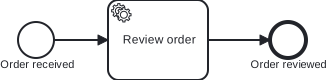
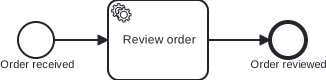
serviceTask_reviewOrderWorker topic <review-order> must match <camelCase>
Invalid: the topic review-order is off the default camelCase scheme
The same, as XML. 👎 wrong:
<bpmn:serviceTask id="serviceTask_reviewOrder" camunda:type="external" camunda:topic="review-order" />
<bpmn:serviceTask id="serviceTask_reviewOrder">
  <bpmn:extensionElements>
    <zeebe:taskDefinition type="review-order" />
  </bpmn:extensionElements>
</bpmn:serviceTask>
👍 right:
<bpmn:serviceTask id="serviceTask_reviewOrder" camunda:type="external" camunda:topic="reviewOrder" />
<bpmn:serviceTask id="serviceTask_reviewOrder">
  <bpmn:extensionElements>
    <zeebe:taskDefinition type="reviewOrder" />
  </bpmn:extensionElements>
</bpmn:serviceTask>
Why
A worker topic is a contract between the model and the code. The worker subscribes to exactly this string, so a developer writing the worker has to find it, an operator reading Cockpit or Operate has to recognise it, and nothing fails at deploy time when two teams spell it differently. A scheme such as billing.validateInvoice says which service owns the work and what the work does. Without one the scheme lives in a wiki page nobody checks, and a topic like validate-invoice next to ValidateInvoice leaves the developer guessing which worker picks it up.
Camunda 7 calls this string a topic, Camunda 8 a job type. It is the same contract, so one rule with one scheme covers both, and a team that moves from Camunda 7 to 8 keeps its configuration.
Why this matters for agentic BPMN
An agent that adds a service task has to invent a topic. With no stated scheme it copies whatever shape it saw last, and the result deploys cleanly while no worker ever fetches the job.
Typical AI artifact without this rule: billing.validateInvoice, validate-invoice and ValidateInvoiceTopic in one model, each from a different edit.
What this rule guarantees: every worker topic follows one configured scheme, so a tool can generate a topic that passes from the same .bpmnlintrc.
Scope
The rule reads the topic where the engine keeps it:
- Camunda 7 and Operaton:
camunda:topicoroperaton:topicon an external task (camunda:type="external"oroperaton:type="external"). That covers a service, business rule or send task, reported on the task, and the message event definition of a throw or end event, reported on the event. - Camunda 8: the
typeof<zeebe:taskDefinition>in an element's extension elements, reported on that element.
It leaves these alone:
- A missing topic or job type. That is a deploy error the engine layer reports, not a naming finding.
- An expression (
=…in FEEL,${…}or#{…}in JUEL). The engine resolves it at runtime, so there is no fixed value to check. - A task that is not external, even if it carries a
camunda:topicattribute.
The rule reads only camunda:, operaton: and zeebe: attributes, so a diagram without workers never produces a finding.
Configuration
Every option is optional. Without any, the rule checks the default scheme: camelCase segments joined by a dot.
| Option | Default | Effect |
|---|---|---|
prefix | none | Fixed text every topic starts with, followed by the separator. |
separator | . | Joins the prefix and every segment. |
case | camelCase | Shape of every segment: camelCase, PascalCase, snake_case, kebab-case or any. |
segments | one or more | Exact number of segments after the prefix. Any value but a positive integer is ignored. |
An unknown case falls back to PascalCase, the same way element-id-naming does. A dot inside the prefix does not count as a segment: { "prefix": "com.acme.billing", "segments": 1 } accepts com.acme.billing.validateInvoice.
| Configuration | Passes | Reported |
|---|---|---|
| none | validateInvoice, billing.validateInvoice | validate-invoice |
{ "prefix": "billing" } | billing.validateInvoice | validateInvoice, billing.ValidateInvoice |
{ "segments": 2 } | billing.validateInvoice, shipping.validateInvoice | validateInvoice, billing.invoice.validateInvoice |
{ "prefix": "billing", "separator": "/", "case": "kebab-case" } | billing/validate-invoice | billing/validateInvoice |
Several services
One .bpmnlintrc often covers several services, each with its own lead (billing.…, shipping.…). Two ways to check that:
{ "segments": 2 }in the shared.bpmnlintrcfixes the shape<service>.<name>for every service. It does not know the service names, so a typo such asbiling.validateInvoicepasses.- One
.bpmnlintrcper service, each with its ownprefix, checks the service name exactly. Run bpmnlint once per service, for examplenpx bpmnlint --config services/billing/.bpmnlintrc "services/billing/**/*.bpmn".
A tool that creates BPMN reads the same options through the exported naming helpers. It builds the topic from the prefix and a name it was given, never a guessed service, and checks the result:
import { naming } from '@miragon/bpmnlint-plugin-rules';

const scheme = new naming.ValueNamingScheme({ segments: 2 });

scheme.matches('billing.validateInvoice'); // true
scheme.describe(); // '<camelCase>.<camelCase>'
Further reading
- Camunda 7: External tasks: how a worker fetches and locks work by topic name.
- Camunda 8: Job workers: how a worker subscribes to a job type.
Related
@miragon/rules/message-name-naming: the same scheme options for message names.@miragon/rules/element-id-naming: the convention for element IDs.