
@miragon/rules/flow-through-element
Reports a sequence flow whose drawn path is routed through the body of a shape it does not connect to.
Examples
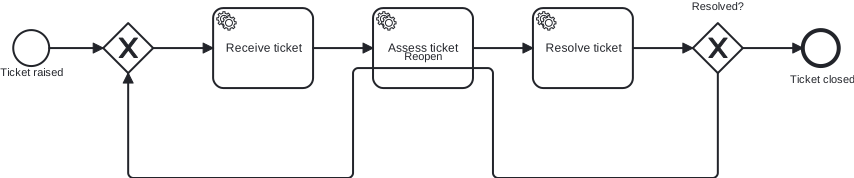
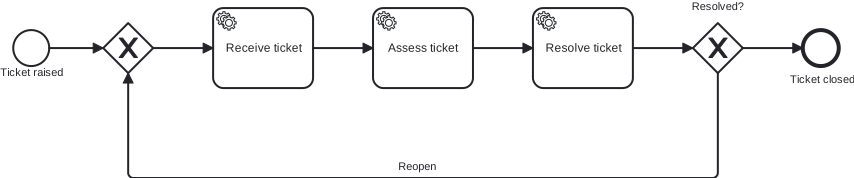
flow_reopenSequence flow is routed through element <serviceTask_assessTicket>
Invalid: the Reopen loop-back is drawn straight through serviceTask_assessTicket, which it does not connect to
Why
The diagram is the artifact a reviewer signs off on and that downstream tooling parses, so it has to match the semantics. A flow drawn straight through an unrelated task breaks that on both counts: the reviewer reads a connection that is not there, and code reading the geometry can treat the pass-through as a real link. bpmnlint's no-overlapping-elements does not catch it, because it only compares shape-vs-shape bounds and never inspects edge geometry.
Why this matters for agentic BPMN
Agents and auto-layout write DI coordinates directly instead of routing edges the way a modeler does, so a flow is easily drawn straight across a shape it has nothing to do with. The semantics stay untouched, so the XML diff looks clean and the defect slips through code review; it shows only once the diagram is rendered.
Typical AI artifact without this rule: a re-routed sequence flow whose waypoints run through the body of an unrelated task, invisible in the XML review and only obvious once the diagram is drawn.
What this rule guarantees: a sequence flow only ever passes through shapes it actually connects to, keeping the rendered model faithful to its semantics and safe to process programmatically.
What it does not report
Shapes a flow may legitimately pass over are excluded:
- Enclosing containers: pools, lanes, groups, and expanded sub-processes. A flow drawn "over" a container it lives inside is not a defect. A collapsed sub-process is a task-sized box and is treated as an obstacle.
- Boundary events and their host: a boundary event sits on its host's border, so the flow leaving it starts inside the host's bounds.
- Decorative overlays: text annotations, groups, data objects and data stores.
- The flow's own source and target.
Container membership uses moddle inheritance, so bpmn:Transaction and bpmn:AdHocSubProcess count as sub-processes.
Known limitations
Left to visual review: a flow drawn over a text label, and message-flow / association routing.
Further reading
- Camunda: Creating readable process models: the layout guidance a flow drawn through an unrelated shape breaks.