
@miragon/rules/flow-crossing
Reports a pair of sequence flows whose drawn paths cross each other within the same plane.
Examples
Both models are the same order review, where Approved? either finalizes the order or sends it to Revise order, which ends in its own Order revised outcome.
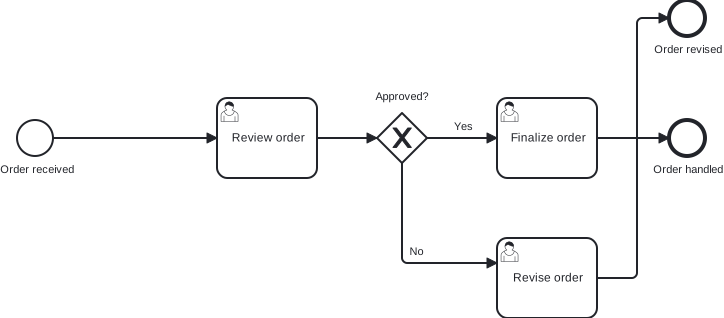
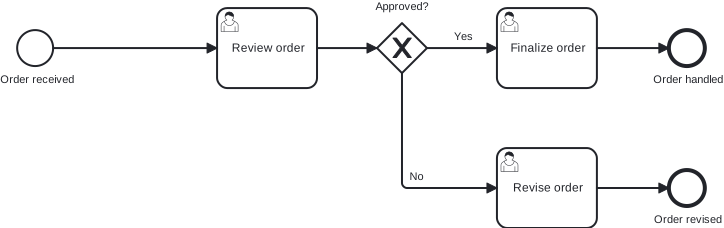
flow_finalizedSequence flow crosses <flow_orderRevised>flow_orderRevisedSequence flow crosses <flow_finalized>
Invalid: the flow from Revise order to Order revised is routed up to a top-right end event, crossing the Finalize order to Order handled flow
Why
The diagram is the artifact a reviewer signs off on and that a stakeholder reads to follow the process. Two flows that cross create a visual knot exactly where the reader is trying to trace which path leads where, so a rejected order and a loop-back become hard to tell apart at the one point they overlap. The crossing lives only in the DI coordinates, so it never shows in the semantic XML and no structural rule catches it. bpmnlint's no-overlapping-elements compares shape-vs-shape bounds and never inspects waypoints, so an edge crossing another edge slips through.
Why this matters for agentic BPMN
Agents and auto-layout write waypoints directly rather than routing edges the way a modeler drags them, so a loop-back or a branch is easily drawn straight across an unrelated flow. The semantics stay correct, the XML diff looks clean, and the tangle shows only once the diagram is rendered for a human to read.
Typical AI artifact without this rule: a flow to a separate outcome routed straight up across the main path, crossing a forward flow it has nothing to do with, invisible in the XML and obvious only once the diagram is drawn.
What this rule guarantees: no two sequence flows form an X in the rendered diagram, so every path can be traced without untangling it from another.
What it does not report
The rule stays conservative, so it never fires on a clean diagram:
- Overlap: two flows that run on top of each other (collinear) are allowed. Only a true crossing, where one flow strictly passes from one side of another to the other, counts.
- Shared node: a pair of flows that leave or enter the same element (a gateway fan-out or fan-in) is skipped, so branch flows splaying from a common tip never report each other.
- Touching endpoints: a flow whose endpoint lands on another flow's line (a T-junction) touches but does not cross.
Comparison is scoped per bpmndi:BPMNPlane, so a drill-down diagram is never measured against the main one.
Further reading
- Camunda: Creating readable process models: the layout guidance that crossing flows break.
Related
@miragon/rules/flow-through-element: the companion geometry rule for a flow routed through a shape rather than across another flow.