
@miragon/rules/flow-connection-side
Reports a sequence flow that docks onto a shape at the wrong side: an event entered from the top, an activity exited to the left, or a gateway connected on a diagonal flank instead of one of its four tips.
Examples
An order-approval process with a rework loop: an intake gateway, a review task, an "Approved?" decision, a finalize task and an end event on the main lane, and — when the order is not approved — a rework path back to the intake gateway. The Approved? gateway initiates the return flow: its no branch runs down-and-left (a backward flow), so it exits on one of the gateway's forward tips and Revise order is re-entered on its mirrored (right) side. Revise order is then a chain member — already inside the return lane — so it exits on the mirrored (left) side and runs on into the intake gateway (the return flow's target, re-entered at a tip). All three return-flow roles from the table above appear in one loop.
The invalid model mis-docks two flows:
- Forward (gateway):
flow_toDecisionlands on the diagonal flank ofgateway_approvedinstead of a tip. - Return target: the
nobranch (flow_revise) entersuserTask_reviseOrderfrom the left, but the target of a return flow must be entered on the mirrored right side.
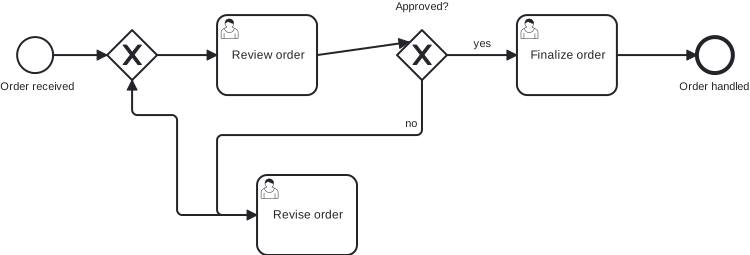
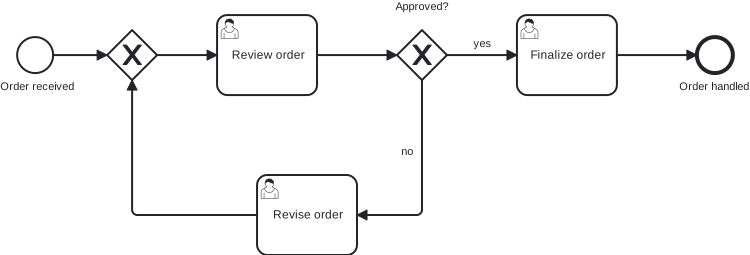
flow_toDecisionSequence flow connects to <gateway_approved> on a diagonal; a gateway must connect at one of its four tipsflow_reviseSequence flow enters <userTask_reviseOrder> from the left; an activity must be entered from the right
Invalid: a forward flow on a gateway diagonal and a return flow entering the wrong face
<!-- 👎 onto the gateway's slanted flank; the return target is entered from its left -->
<bpmndi:BPMNEdge bpmnElement="flow_toDecision">
  <di:waypoint x="460" y="200" />
  <di:waypoint x="552" y="187" />
</bpmndi:BPMNEdge>
<bpmndi:BPMNEdge bpmnElement="flow_revise">
  <di:waypoint x="565" y="225" />
  <di:waypoint x="565" y="280" />
  <di:waypoint x="360" y="280" />
  <di:waypoint x="360" y="360" />
  <di:waypoint x="400" y="360" />
</bpmndi:BPMNEdge>

<!-- 👍 into the gateway's left tip; the gateway initiates the return flow into the task's right -->
<bpmndi:BPMNEdge bpmnElement="flow_toDecision">
  <di:waypoint x="460" y="200" />
  <di:waypoint x="540" y="200" />
</bpmndi:BPMNEdge>
<bpmndi:BPMNEdge bpmnElement="flow_revise">
  <di:waypoint x="565" y="225" />
  <di:waypoint x="565" y="360" />
  <di:waypoint x="500" y="360" />
</bpmndi:BPMNEdge>
Why
A BPMN diagram is the shared picture a modeler, a reviewer and a business stakeholder read to follow the process, and it reads cleanly only when it flows left to right: the main path enters a shape on the left and leaves on the right, and gateways branch through the tips of their diamond. When a flow attaches somewhere else the reader has to stop and trace where each arrow actually lands to see the path, even though the semantics (source, target) are perfectly valid.
Why this matters for agentic BPMN
Agents and auto-layout write DI coordinates directly. They get the connection right semantically but dock the edge wherever the maths lands: into the top of a task, out of the left of a gateway, onto the slanted flank of a diamond. The XML review looks clean; only the drawn diagram shows the mess, and a reader (or a downstream layout pass) can no longer tell the main path from a branch.
Typical AI artifact without this rule: a flow that enters an activity from above or a gateway on its diagonal edge: semantically fine, visually unreadable.
What this rule guarantees: every sequence flow attaches at a side that matches the element and the flow direction, so the rendered model reads as a left-to-right process.
Scope
Only the DI coordinates decide: for each sequence flow, the first waypoint is its exit off the source, the last waypoint its entry into the target. The docking side is compared against a fixed per-direction, per-type policy:
| Element | Incoming (target) | Outgoing (source) |
|---|---|---|
| Event | left | top, right or bottom (any but left) |
| Activity | left | right |
| Gateway | top, bottom or left tip (any but right) | top, right or bottom (any tip but left) |
The main flow always enters on the left. An activity exits to the right; an event may branch its outgoing flow out any side except the incoming-left one, the same freedom a gateway has. A gateway is entered at any tip but the forward-right one (the mirror of that exit rule — a flow arriving on the right face is coming back against the main direction). A gateway is a diamond, so its only clean anchors are the four tips (the midpoints of its bounding box); a point on a diagonal flank is reported as a diagonal connection.
Return flows
A return flow is a loop-back edge whose target is drawn clearly left of its source — decided from the two shapes' horizontal centres, with a small tolerance so a near-vertical loop (target in roughly the same column as its source) is not treated as a return flow and keeps the strict left-to-right policy above.
A return flow reads right-to-left, so its docking is judged against a mirrored form of the policy (left and right swapped, top/bottom unchanged). The target end is always mirrored; the source end depends on the element's category:
| Element | Target — entered (mirrored) | Source, initiator — exits | Source, chain member — exits |
|---|---|---|---|
| Event | right | any side | any side |
| Activity | right | right | left |
| Gateway | top, bottom or right tip | any tip | any tip |
- Target (entered). Always mirrored — an activity is re-entered from the right, an event from the right, a gateway at any tip but the forward-left one. A return flow that wraps into the wrong face (e.g. enters an activity from the left, its forward-input side) is still reported.
- Source — gateway or event. A branch point: on a return flow it may dock the branch at any tip — a forward tip (top/right/bottom) to wrap around, or the mirrored left tip to head straight back. Its role in the return path does not matter here. The "not left" restriction only bites on a forward flow, where leaving left would mean doubling back into the incoming face.
- Source — activity. The linear backbone, so it keeps the strict role distinction. An element that initiates the loop-back (a forward-lane activity not itself the target of a return flow) exits on its forward (right) side and wraps around; a short direct return leaving an activity to the left is reported. A chain member (an activity that is already the target of a return flow, so it sits inside the return lane) exits on the mirrored (left) side, continuing the leftward chain.
The activity role is read from the graph, not guessed from coordinates: an activity counts as a chain member exactly when some other return flow targets it.
Stub length
On top of the side, a flow must leave (and enter) with a stub: its first segment has to run at least minStubLength px straight out of the docked side before it turns. Otherwise an edge can dock on the correct side and immediately bend away — which renders as an arrow leaving a corner with no visible direction. The stub is measured along the docked side's outward normal (right → +x, left → −x, top → −y, bottom → +y), so it is the same check for an activity edge, an event edge and a gateway tip; boundary events are left alone here too. minStubLength defaults to 20; set it to 0 to switch the stub check off. The side is judged first — a wrong-side connection is reported as such, not as a short stub.
Comparison is scoped per BPMNPlane. Left alone: shapes with no category (pools, lanes, data objects), boundary events (they sit on their host's border, so a flow leaving one may dock at any side), and any docking point too ambiguous to classify (exactly on a corner). These are never guessed, to avoid false positives.
Configuration
"@miragon/rules/flow-connection-side": [
  "error",
  { "allowBackwardsFlow": false, "minStubLength": 20 }
]| Option | Default | Effect |
|---|---|---|
allowBackwardsFlow | true | Apply the return-flow policy (see above). Set to false to hold every flow to the strict left-to-right policy — a return flow's docking is then reported like any other wrong-side connection. |
minStubLength | 20 | Minimum px a flow must run straight out of (and into) its docked side before turning. Set to 0 to switch the stub check off. |
Further reading
- Camunda: Creating readable process models: the left-to-right layout guidance a mis-docked flow breaks.